


Hello there! Welcome to Fiery Word
If you haven’t already done so, please subscribe to this newsletter. It is free and goes directly to your inbox when you subscribe.
Kindly take a second to subscribe and share with somebody today.
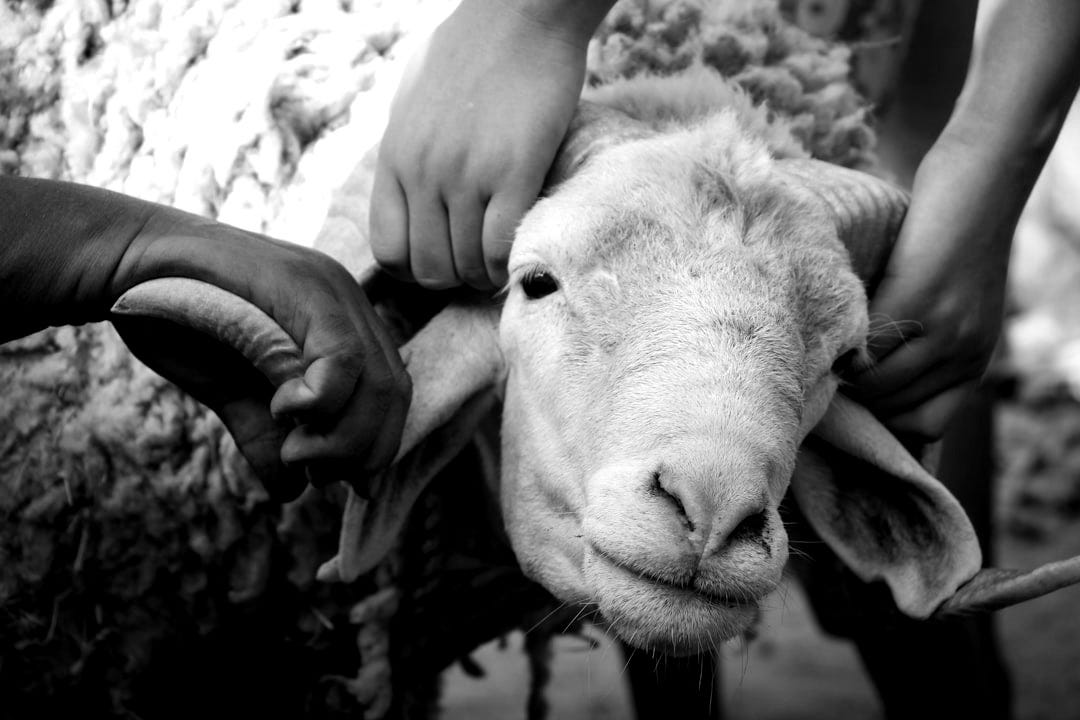
“He entered once for all into the holy places, not by means of the blood of goats and calves but by means of his own blood, thus securing an eternal redemption.” — Hebrews 9:12
The Garden Instruction
The first thing Jesus says to anyone after the resurrection is a prohibition.
Mary is in the garden before dawn. She has already seen the stone rolled away and run to tell the disciples. She has watched Peter and John come and go, leaving her alone again at the entrance to an empty tomb. She is weeping when she turns and finds a man standing behind her, and she mistakes Him for the gardener. Then He speaks her name, one word, Mary, and she knows. She turns and calls out Rabboni, my Teacher, and moves toward Him.
And He stops her. Do not hold on to me, He says, for I have not yet ascended to my Father.
This is the most theologically loaded sentence Jesus speaks in any of the resurrection appearances, and it is the one most often treated as a minor narrative detail, a touching scene with an unexplained restriction, before the story moves on to Thomas and the upper room and the Sea of Galilee. But the restriction is not incidental. It is the key to everything that happens in the forty days between the resurrection and Pentecost. Jesus is not simply alive. He has risen as the High Priest of a new covenant, and He is carrying something, and a high priest does not receive the worship of the people before he has entered the sanctuary and presented the sacrifice.
He died as the Lamb. He rose as the Priest. The work of the Lamb was finished on the cross. The work of the Priest had not yet begun.
What the Curtain Was Saying
For fifteen hundred years Israel had understood one thing clearly about the presence of God: you could not simply walk into it. The architecture of the Tabernacle and then the Temple made this plain in wood and stone and curtain. The outer courts were accessible. The inner courts required preparation. The Holy of Holies, the innermost room where the ark of the covenant sat between the cherubim and the presence of God rested, that room was accessible to exactly one person, on exactly one day, under exactly one condition.
The high priest, on the Day of Atonement, Yom Kippur, entered the Holy of Holies carrying the blood of a bull and a goat. He sprinkled it on the mercy seat. He made atonement for the sins of Israel for another year. Then he came out, and the curtain fell back into place, and the way into the presence of God was closed again for twelve months.
The curtain was not decorative. It was a declaration. The way into God’s presence is not yet open. The blood of animals could cover sin for a season, but it could not remove it. It could not cleanse the conscience. It could not deal with the spiritual root of the problem, which was not a record to be periodically cleared but a nature to be entirely renewed. So the high priest went in every year, and every year the curtain came down again, and the fifteen hundred years accumulated into a testimony that what was being done inside the Holy of Holies was necessary and real and profoundly, permanently insufficient.
When Jesus died, the curtain was torn from top to bottom. Not from the bottom, where a man might reach. From the top, where only God could reach. The declaration was over. The annual system was not suspended. It was superseded. A different blood was on its way to a different sanctuary, and when it arrived, the curtain would never need to fall again.
Once for All
Hebrews 9 is the scripture most people associate with the mechanics of Old Covenant sacrifice, and read it quickly on the way to the promises. But slow down in verse 12, because what is being described there is the most significant priestly act in the history of the universe.
He entered once for all into the holy places, not by means of the blood of goats and calves, but by means of his own blood, thus securing an eternal redemption. The phrase once for all translates the Greek ephapax, a word that does not simply mean one time in the past. It means that the singular occurrence exhausts the category. There will be no second offering because the first one was complete. There will be no annual repetition because the one entry accomplished what fifteen hundred years of annual entries could only gesture toward. Ephapax. The word slams a door on every system that requires ongoing appeasement, every religion built on the idea that God must be continually satisfied by human performance. Jesus entered once. The once was enough for all of time.
The disciples did not know this was happening. In the days between the resurrection and the ascension, while they were gathered in locked rooms and walking roads to Emmaus and fishing on the Sea of Galilee, their High Priest was performing the most decisive priestly act in human history in a sanctuary none of them could see. He carried His own blood, the blood that had been shed on the cross, into the heavenly Holy of Holies, the real sanctuary, the one the earthly Temple had always been a shadow of, and He presented it before the throne of the universe. The Father accepted it. The supreme court of eternity received the offering and rendered its verdict: sufficient. Eternal. Unrepeatable.
Hebrews 12:24 adds the detail that deserves its own paragraph. The blood of Jesus speaks. Not spoke, past tense, as though the presentation happened once and is now archived in the records of heaven. Speaks, present tense, ongoing, active, continuous. At this moment, the blood that Jesus carried into the heavenly sanctuary is speaking before the throne of God. And what it says is not accusation. It speaks better things than the blood of Abel, Hebrews says. Abel’s blood cried from the ground for justice. The blood of Jesus speaks for mercy. It speaks what was declared on the cross: it is finished. It speaks what the empty tomb confirmed: accepted. It speaks what the ascension sealed: eternal.
The way into the presence of God is not closed. It has not been closed since the moment Jesus entered with His blood. The curtain that fell every year for fifteen hundred years was torn on Good Friday, has not fallen since and can never fall again.
Come Boldly
Hebrews 4:16 gives the instruction that only makes sense in light of everything that precedes it. Let us come boldly to the throne of grace, that we may obtain mercy and find grace to help in time of need. The boldness is not a personality trait the author is commending. It is the theologically correct response to what has been accomplished. The throne of grace is not a throne that requires fresh appeasement before it can be approached. It is a throne before which the High Priest has already stood, with blood that speaks, having secured not a seasonal covering but an eternal redemption. The appropriate way to approach such a throne is with confidence, because anything less is a failure to believe that the presentation was accepted and the way was opened.
This is the message the believer most needs to carry into their interior life. The cross established the legal ground of redemption. The three days completed the transaction in the spirit realm. The ascension and the blood in the heavenly sanctuary sealed it before the throne of the universe. And the result is that the person united to Christ has a standing before the Father that does not fluctuate with their performance, does not diminish when they fail, does not require daily renegotiation. They have a High Priest who ever lives to make intercession for them, Hebrews 7:25 says. Not who made intercession, past tense. Who ever lives to make it, present continuous, uninterrupted, permanent.
Timidity before God, then, is not humility. It is a failure of theology. It is treating the curtain as though it had not been torn, approaching the presence as though the blood had not been presented, living as though the annual system were still in effect and the way were not yet open. The believer who prays with their eyes on their own inadequacy rather than on their High Priest has not grasped what happened in the forty days between the garden and the upper room. They have a better covenant established on better promises, Hebrews 8:6 says, and the better promises include this: that the One who bore their sin is the same One now standing before the Father on their behalf, and the blood He presented there speaks, and what it speaks is mercy.
You are not approaching a throne that requires you to earn your audience. You are approaching a throne before which your name has already been spoken, your debt has already been settled, and your High Priest is already standing. Come boldly. The way is open. The blood is speaking. And it is speaking for you.
We pray:
Father, we confess that we have often approached You as though the curtain were still intact. As though something more were required of us before the way were open. As though the blood Your Son carried into the heavenly sanctuary were somehow insufficient for people like us, in seasons like this, with records like ours.
Forgive us for the smallness of that approach. Forgive us for the timidity that masquerades as humility but is in fact a failure to believe what the blood is saying. Right now, at this moment, the blood of Jesus is speaking before Your throne. It is speaking mercy. It is speaking finished. It is speaking our names into a redemption that is eternal and unrepeatable and held.
We receive our High Priest. We receive the access He has purchased. We receive the boldness that is not our own confidence but the confidence of the blood, the confidence of the ephapax, the once-for-all that exhausted every claim against us and opened a way that has not closed since He entered.
Teach us to live from this. Teach us to pray from this. Teach us to stand before You not as people nervously calculating whether they have done enough, but as people whose High Priest is already standing, already speaking, already interceding. The way is open. We are coming in. In the name of the One who opened it and who ever lives to keep it open.
Amen.