


Hello there! Welcome to Fiery Word
If you haven’t already done so, please subscribe to this newsletter. It is free and goes directly to your inbox when you subscribe.
Kindly take a second to subscribe and share with somebody today.
“For it is by grace you have been saved, through faith, and this is not from yourselves, it is the gift of God, not by works, so that no one can boast. For we are God’s handiwork, created in Christ Jesus to do good works, which God prepared in advance for us to do.”— Ephesians 2:8-10
The Cliff’s Edge
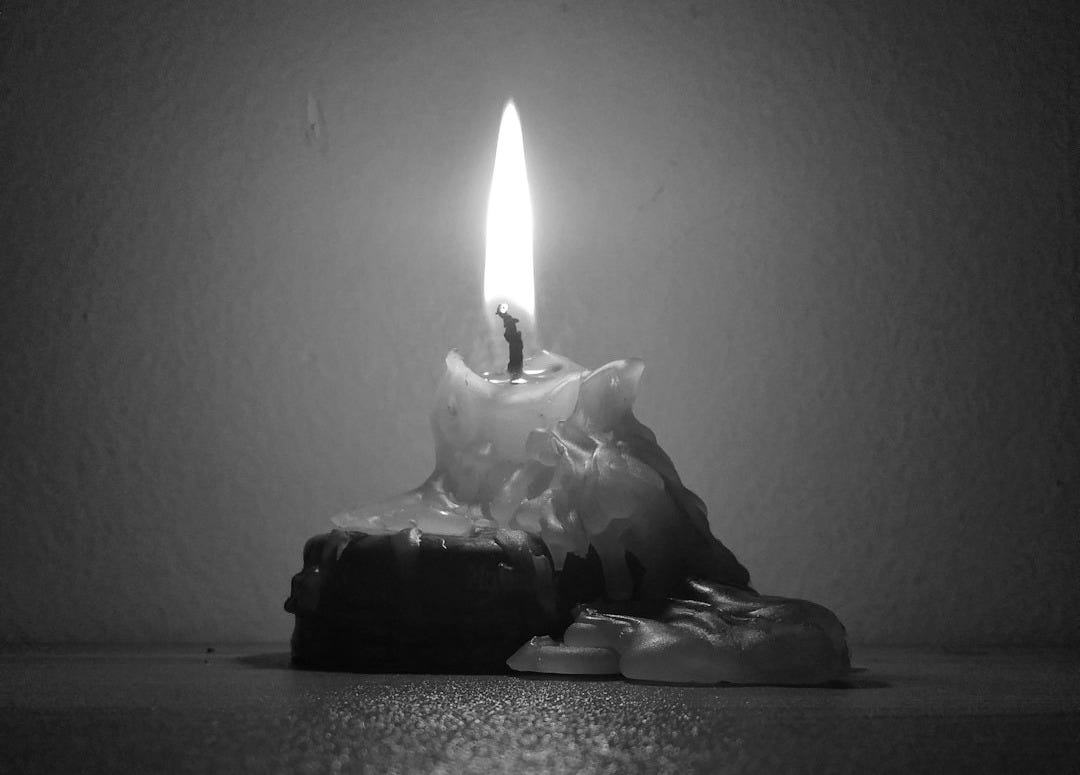
The older I get, the more difficult things become, and the more spectacular the breakthrough by which they come. Once I was younger and exuberance powered me. I say this at the ripe old age of twenty-seven. I would say to the many mountains in my life, move from here to there, and by sheer will they would move, or at least I thought so. If I worked hard enough, if the midnight candle was not spared, then all my dreams and ambitions would surely be achieved. And for a while God allowed it. The knowledge of Christ was still far away in my Gentile statehood, though His grace was always beside me. As that knowledge has drawn close, as I have been grafted into the tree that is Christ, something has changed. White-knuckling appears to work no more, and God in His most dramatic form waits until I am on the cliff’s edge of a landslide to pull me from the brink. This concept of grace that cannot boast has found its illumination in my heart both theologically and practically.
Paul did not write these Ephesian verses as a primer on salvation. He wrote them as a verdict. The Ephesian church was a Gentile congregation pressed on every side by the temptation to add something, anything, to the work Christ had finished. Add the law, add lineage, add ritual, add the credentials of a properly ordered religious life. Paul will have none of it. He builds the sentence with deliberate architecture and lands it on a single phrase that refuses to be softened. Hina mē tis kauchēsētai. So that no one can boast. The Greek carries a finality the English cannot quite hold. It is not that boasting is discouraged, but that boasting is structurally excluded. The gate of grace has been built too narrow for self-congratulation to pass through alongside us.
This is not Paul being polemical. This is Paul being precise. He returns to the same conviction in Romans 3:27 with even sharper language. Where then is boasting? Exekleisthē. It has been shut out, locked away, slammed-door style, by the very nature of the gospel itself. The verb here is passive, which is to say the action is complete and it is not something we did. Boasting did not retreat on its own but was forcibly removed from the room by the structure of how God chose to save. To rebuild it is to fight the architecture of grace itself.
We must feel the weight of what Paul is doing. He is not merely saying that we should not boast, as though humility were a virtue we cultivate alongside our salvation. He is saying that the very mechanism of salvation has been designed to make boasting impossible. God did not save us in a way that left a back door open for human pride. He saved us in a way that closed the door, sealed it, and threw away the key. Any boasting that re-enters has climbed in through a window the gospel did not provide.
And this is mercy. We do not always recognize it as such. The flesh would prefer a salvation that left some small territory for our contribution, some narrow ledge where we could plant a flag and say, this part was mine. But God in His severe kindness denies us that ledge. He knows what would happen to us if even a fraction of the glory could be claimed. The same pride that unmade Lucifer and undid Eden would find its foothold again. So He saves us by a grace so total that no flag can be planted in it. The cross does not negotiate.
Grace That Will Not Be Earned
This Ephesian verse opens with three words that have anchored the church for two thousand years. Tē gar chariti. For by grace. The definite article matters. Paul does not invoke grace in the abstract but points at a specific grace, a particular and named grace that has a history and a face, and His name is Jesus. Then comes the means. Dia pisteōs. Through faith. The preposition dia signals channel rather than source. Faith is the pipe through which grace flows to the soul, not the well from which grace is drawn. Faith does not generate salvation; it receives it. Faith is not the engine; it is the open hand. To confuse the two is to make faith itself into a work, and Paul rejects this thinking.
And then the line that has occupied theologians for centuries. Kai touto ouk ex hymōn or “And this is not from yourselves.” Paul reaches for a small word, touto, “this,” and the word is carrying much weight. He does not say “this grace” or “this faith” alone. He says “this,” and the “this” sweeps the whole arrangement into its arms. The grace, the faith, the saving, the entire structure of how God brought us in. None of it is from yourselves. Not the grace that came to find you. Not the faith by which you received it. Not the act of receiving. Paul refuses to leave any piece of salvation available for human claim. Even our believing is a gift. Even our reaching for the cup was placed in us by the One who filled it.
This is why Paul can say with such confidence in the next breath, ouk ex ergōn, hina mē tis kauchēsētai. “Not from works, so that no one can boast.” The two clauses are tethered. Boasting is excluded precisely because works have been excluded. Where works are admitted as the basis of standing, boasting follows them in like a shadow. Where works are barred at the door, boasting has no host to attach itself to. This is the theological architecture of justification by faith, and Paul has built it to be airtight.
But Paul is not finished. He does not stop with what we are not. He moves immediately to what we are. Autou gar esmen poiēma. “For we are His handiwork.” The word poiēma is the same root from which we get the English word poem. We are the made thing, the crafted artifact, the composition. The poet is God and the poem is us. A poem does not write itself. A poem does not stand in the gallery and take credit for its own lines. And then the verse closes with a phrase that should arrest every striving soul. Hois prohētoimasen ho Theos. “Which God prepared in advance.” The good works are not the basis of our standing; they are the path laid out for those already standing. God saved us, made us new, and then unrolled before us the trail He had already mapped from before the foundation of the world. Even our obedience is grace-supplied. We do not invent the road. We walk the one He has already laid.
When the Candle Gutters
There is a question the maturing believer eventually asks, quietly and often without finding the words for it. Why does it seem that the longer I walk with God, the harder the breakthrough becomes to engineer? Why did the prayers of my younger years seem to land more directly, the doors seem to open more obediently, the strength of my own resolve seem to carry me further? Why has the formula stopped working? The question carries within it the assumption that something has gone wrong. The honest answer is that something has gone profoundly right.
Paul faced the same bewilderment in his own life. He had asked the Lord three times to remove a thorn, and three times the answer came back not as removal but as redirection. Arkei soi hē charis mou, hē gar dynamis en astheneia teleitai. “My grace is sufficient for you, for my power is made perfect in weakness.” The English softens what the Greek insists. Teleitai does not mean that power merely emerges in weakness or compensates for it. It means power is brought to its completion, its consummation, its full and finished form, in weakness. Weakness is not the obstacle that grace overcomes. Weakness is the venue where grace becomes itself. The thorn was not the interruption of Paul’s ministry but the architecture of it.
This is the rhythm God establishes with every soul He intends to mature. In the early years He often permits the candle to burn at both ends. He blesses the white-knuckled effort, the all-night studying, the relentless pursuit of every door. He is teaching us by allowing. He is also patient with the residual confidence we carry in our own strength, because we have not yet been shown what it cannot do. But there comes a point in the grafted life when God will no longer permit the candle to be the source. Not because He has grown stingy, but because He has grown serious. He will not split the glory with our willpower. He will not allow the saint He is forming to carry away the testimony as personal achievement. So He waits. He waits until the candle gutters. He waits until the path narrows to the cliff’s edge. He waits until every reserve has been spent and the soul has nothing left to spend. And then, only then, does He move.
This is not cruelty. This is jealousy of the holiest kind. God refuses to share the stage with our striving because He knows what striving will do to the soul that succeeds by it. The believer who breaks through on willpower walks away convinced that willpower is the lever, and the next time the mountain rises we reach for the same lever and find it has been quietly removed. The believer who breaks through on the cliff’s edge walks away convinced of something entirely different. We walk away knowing whose hand caught us, whose strength carried us, whose name belongs on the testimony. The first breakthrough builds a self. The second breaks a self and builds a witness.
To refuse this rhythm is to enter a kind of quiet suffering. The believer who keeps reaching for the old levers does not lose salvation, but loses the joy of it. We become exhausted in a way we cannot quite name, weary not from labor but from labor that has stopped being received. The white-knuckling becomes its own torment, because the soul has been brought into a covenant where independence is no longer permitted. The deeper the grafting, the more painful the attempt to live as though we were still our own. This is why so many seasoned believers describe their middle years as harder than their early ones. It is not that God has withdrawn. It is that He has refused to let us continue mistaking our hand for His.
The Signature on the Poem
Return now to the word Paul could not let pass without using. Poiēma. We are God’s handiwork, His composition, His made thing. The poem does not write itself. The poem does not stand in the gallery and take credit for its own lines. The poem stands as the testimony of the One who shaped its meter, chose its words, and signed His name at the bottom of the page. To be God’s poiēma is to be unable to boast, not because boasting has been forbidden, but because boasting has been rendered absurd. The painting does not congratulate itself on its color and the sculpture cannot lecture the chisel.
This is what the soul finally learns at the cliff’s edge. The breakthroughs that arrive when our strength has run out are not anomalies in the Christian life. They are the signature of the workmanship. They are God writing His name on the piece He is making. The everyday triumphs that come when we are weak and He shows up have a particular quality, a particular givenness, because they are not testimonies of what we did. They are testimonies of whose we are. The deeper we are grafted into Christ, the more these moments multiply, and the more they multiply, the more our story becomes unmistakably His.
This is the practical fruit of justification by faith. The doctrine that excluded boasting at the cross continues to exclude it at every subsequent breakthrough. The same grace that saved us is the grace that sustains us, the grace that opens the door, the grace that lands the word in our mouth, the grace that pulls us from the cliff’s edge. There is no two-stage gospel in which we are saved by grace and then sanctified by willpower. What grace began, grace finishes. The mouth that once said look what I built, look what I overcame, becomes the mouth that says look what was done, look who was faithful. We do not become humble by trying harder to be humble. We become humble by being shown, again and again, that the work has never been ours.
And here the deepest identity comes into view. We are not boast-less because we have been diminished nor are we empty-handed because we have been impoverished. We are boast-less because we have been joined to the One whose name is above every name, and there is no honor we could claim that would not pale beside the honor that is already ours in Him. Union with Christ is the floor on which boasting falls silent. We do not strive for significance because we have been given a significance no striving could produce. We do not engineer breakthroughs because we have been seated with Him in heavenly places. We do not white-knuckle our way through the difficulty because we have been told, plainly and finally, that His grace is sufficient and His power is perfected in our weakness.
This is the inheritance of every believer. Not a life without difficulty, but a life in which the difficulty has been re-purposed. Not the absence of the cliff’s edge, but the presence of the One who waits at it. Not the silencing of testimony, but the changing of its subject. The older we grow in Christ, the less we have to say about ourselves and the more we have to say about Him. The story that began with our striving becomes the story of His sustaining. The poem that began with our straining to write it becomes the poem we finally let Him compose. And when the work is finished and the gallery is opened, the signature at the bottom of the page will read, not by works, so that no one can boast.
Prayer
Father,
We come before You with hands that have known the weight of their own striving and have found it wanting. We have spent our exuberance, burned our midnight candles, said to mountains move from here to there and watched some of them refuse. We have learned, slowly and through the mercy of difficulty, that the strength we trusted in was never the strength that saved us.
Teach us the rhythm of the grafted life. Take from us every quiet boast we have not yet recognized, every flag we have planted in territory that was always Yours. Where we still reach for the old levers, gently remove them from our hands. Where we still mistake our willpower for Your Spirit, expose the difference. Where we still believe the breakthrough belongs to us, return us to the cliff’s edge until we know whose hand it is that catches us.
We confess that we are Your handiwork. We did not write the poem. We are the poem. Every line of our lives that bears the mark of grace was placed there by You, and every line yet to be written waits on Your hand. Make us content to be the made thing. Make us joyful in dependence. Make us free of the exhausting need to prove what You have already settled.
Let our triumphs be small enough to be unmistakably Yours. Let our breakthroughs arrive from directions we did not watch. Let the testimony of our lives leave no room for self-congratulation, only for worship. And when the story of our walk with You is finally told, let it read as one signature from beginning to end, and let that signature be Yours.
In Jesus’ name,
Amen.