


Hello there! Welcome to Fiery Word
If you haven’t already done so, please subscribe to this newsletter. It is free and goes directly to your inbox when you subscribe.
Kindly take a second to subscribe and share with somebody today.
“And it shall come to pass in the last days, saith God, I will pour out of my Spirit upon all flesh: and your sons and your daughters shall prophesy, and your young men shall see visions, and your old men shall dream dreams.” — Acts 2:17
The Day We Keep
Each year the Church moves through a calendar that carries us from Christmas to Easter, from Palm Sunday to Pentecost, which was yesterday. There is a tendency to treat certain dates with a particular gravity, and rightly so, because the calendar is not a series of anniversaries but a yearly rehearsal of the truths we are prone to forget. Pentecost is one of those days that arrives with weight on it, a day the Church sets aside to attend to the movement of the Holy Spirit. But I have come to believe that we do not keep Pentecost in order to beg for a new move of the Spirit. We keep it to be reminded that the fire has already been lit.
This is the work Pentecost does in us as a liturgical exercise. It does not send us out to seek what we lack. It convicts us that we have been living beneath what is already ours. The flame was kindled in all of us long before the day Luke records in his second volume. It was kindled when Joel prophesied, centuries before the veil was torn from top to bottom, before the presence of God moved from inhabiting places to inhabiting people, before the temple of stone was supplanted by the temple of flesh, before a frightened fisherman stood in a doorway in Jerusalem and preached with a boldness no one who knew him would have predicted. Three weeks ago, in Fire on Every Head, we brought to a close a five part series tracing the legal and spiritual architecture beneath the revelation of Scripture. Today we turn from the architecture to the practice. We ask what Pentecost is for.
With, and Then Within
If you want to understand what the Spirit does on the day of Pentecost, watch Peter closely. Not the Peter of Acts 2, but the whole arc of him, because the man who preaches to three thousand is the same man who could not stand before a servant girl. The distance between those two scenes is the entire argument of Pentecost.
We should be careful how we describe what Peter had before the upper room. The Holy Spirit was unmistakably at work in him. No one confesses Christ as the Son of the living God by the power of flesh and blood, and Jesus said as much: that confession was a disclosure, given from above and lodged in him by the Father. The Spirit had given him faith, drawn him from his nets, sustained him in three years of following. But the Spirit was with Peter in the way the Spirit had always been with the people of God under the old covenant, present and active, and yet not permanently established within him. There is a difference between the Spirit being with a person and the Spirit indwelling and filling that person with abiding power, and the whole of redemptive history bends toward closing that gap.
The Old Testament is the long record of a God who came near His people but remained, in a real sense, apart from them. He went before them as a pillar of cloud by day and fire by night, near enough to lead, separate enough that no one mistook the cloud for kinship. He met Moses on the mountain, and Moses, having tasted that nearness, pleaded that the presence itself would go with them, knowing a promised land without the presence was no gift at all. The Shekinah glory filled the tabernacle so heavily the priests could not stand to minister, the presence dwelling in the midst of the camp and yet sealed behind a veil, accessible to one man, one day a year. God was with His people, but God was not yet within them. The whole architecture of tent and temple and curtain was a fifteen hundred year sermon on that single, aching word: with.
Then, on the night before the cross, Jesus changes the preposition. I will ask the Father, He says, and He will give you another Advocate to be with you forever. The word at the end of the sentence is load bearing. Another Advocate, of the same kind as Himself. To be with you, yes, but then the word that breaks the old pattern open: forever. The presence that had come and departed, that had filled the tent and then withdrawn behind the veil, that Moses had to beg to remain, would now take up residence and never leave. Forever means no more coming and going, no more nearness held at the distance of a curtain. For everyone who receives Him, the separation is over. The God who was with His people would now be the God within them.
This is why Pentecost is not Peter engaging the Spirit for the first time. It is the Spirit moving from with him to within him, from companion to indwelling, from presence alongside to power inside. The same mouth that said I do not know Jesus preached the resurrection until a city trembled, not because something foreign had been installed, but because the One who had walked beside him had now come to dwell in him and would never again depart. Paul says the gifts and the calling of God are without repentance, that God does not change His mind or regret what He gives, and if that is true of any gift it is most true of this one, because here the gift is not a thing God hands us. The gift is God, given to us, to stay.
Raniero Cantalamessa names the condition that befalls those who have received this gift and let it go cold. “If it seems to us that we have all the symptoms of this dark disease of the spiritual life, lukewarmness, and we feel worn out, cold, disinterested, apathetic, dissatisfied with God and with ourselves, there is a remedy and it is infallible: we need a good, healthy Pentecost.” This is the diagnosis of our time, not a description of someone else. And the remedy is the whole argument of Pentecost in a single phrase, because it does not prescribe a new conversion or a fresh acquisition. It prescribes Pentecost itself, the rekindling of what the dark disease has merely buried. For us who live after the upper room, the Spirit’s work is never a matter of acquisition. It is far more often a matter of discovery and recovery. We spend our energy asking God for what He has already given and will never take back, and the asking becomes a way of avoiding the more searching question, which is why what He gave has grown so dim.
No One Is Spared the Fire
Now look closely at what Joel actually does, because the grammar is the sermon. The prophecy does not divide humanity into the Spirit-haves and the Spirit-have-nots. It is not that some will receive and others will not. Every category named, sons, daughters, young, old, and in Joel’s next verse even male and female servants, receives something. The distribution is of mode, not of access. The scandal is not that everyone gets the same gift. It is that no category is excluded from receipt. The Spirit, once poured out, refuses to leave anyone who accepts Christ without sight or direction.
The old man whose future is mostly behind him still gets a dream. The servant girl with no name in the record still prophesies. In the economy of the Spirit there is no one too young to see and no one too old to be given more. This is what it means that the Spirit was poured out on all flesh. Pentecost spares no one. There is no category of believer for whom the fire is optional, no station so low it is overlooked and none so settled it is exempt. And if no one is spared the fire, then no one is permitted the slow drift into lukewarmness, that cold and comfortable dissatisfaction with God that mistakes itself for maturity. To be filled is to be made restless toward more. The believer who feels nothing is not beyond the reach of the fire. He is a hearth where the fire has been let go untended, and the prophecy of Joel stands over that hearth as both promise and rebuke.
They Received, and Received Again
Read on through Acts and you find something that should unsettle anyone who treats Pentecost as a single, finished transaction. Watch Peter alone and you will notice he is filled in the upper room when the Spirit descends. Yet when he stands before the rulers and elders a few chapters later, Luke says he was filled with the Holy Spirit again, as though the fire that fell at Pentecost needed to fall afresh for the hour in front of him. And when the whole company prays under threat, the place is shaken and they are all filled again and speak the word with boldness, the same people, the same Spirit, a second filling on top of the first. Paul shows the same pattern, filled at his conversion and filled again at a later moment of confrontation. This is why, when the apostle turns to command it in Ephesians 5:18, he does not tell the Ephesians to be filled once and be done. The verb he reaches for is plērousthe, present tense and passive, a thing done to us and never finished being done, so that the command lands not as fill yourselves but as go on being filled, keep on being filled, submit again and again to the filling you cannot manufacture. In Acts, Luke is not recording a single ignition followed by self sustaining flame. He is recording a rhythm of rekindling, a people returning again and again to the same fire, not to start a new one but to revive the one already burning low.
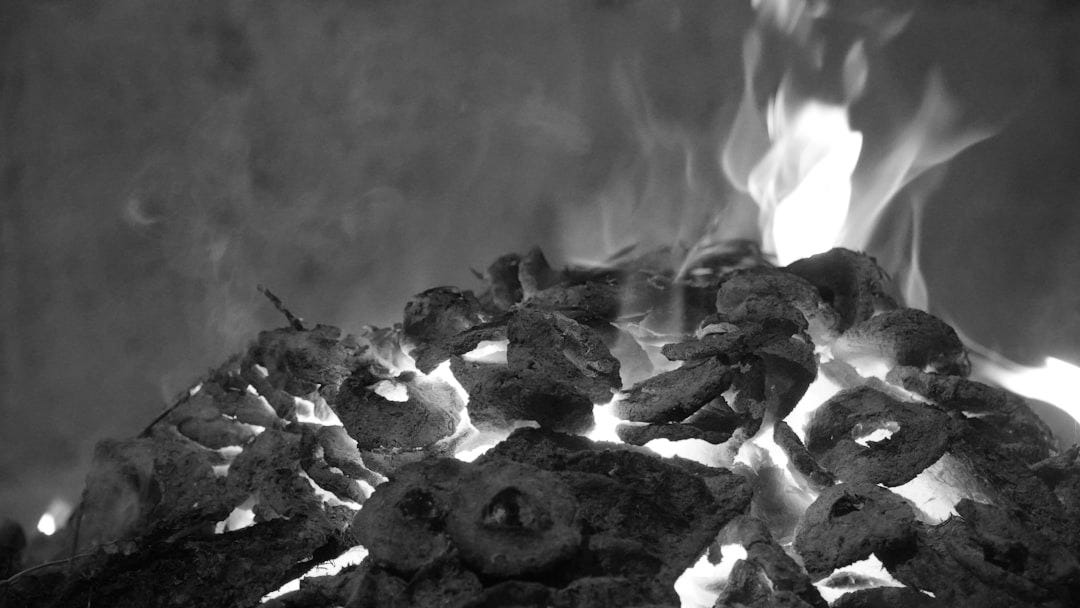
This is the practicality of Pentecost, and it is the thing we most need to hear. The Christian life is not lit once and left to burn on its own. We are the wood, and the Holy Spirit is the fire, and there comes a season in every believer’s life when the fire looks dead. The worship that once cost us tears has become routine. The service that once felt like privilege has become obligation. The Scripture that once burned has gone quiet. We look at the cold grey hearth and conclude the fire has gone out, and we begin, wrongly, to ask God to start over.
But the fire is not dead. Under the ash there is an ember, and the ember does not need a new flame. It needs wind. It needs breath. It needs the same Spirit who first descended to come again, not as a stranger but as the One who has been there all along, breathing until the dying coal glows red again and the wood remembers what it was made for. This is why we keep Pentecost. Not to receive a Spirit we do not have, but to be reminded, and rekindled, and recalibrated, until the fire that was always ours is once more the fire by which we live.
We pray:
Father, we come to You as people who have been given much and have let much grow cold. We confess that we have asked You for fire while standing over hearths still warm with the coals You lit long ago. Forgive us for treating the dimness as absence, for mistaking our weariness for Your withdrawal, for begging a new Spirit when the One we received has never once left us.
We remember Peter, faltering by the fire before the Spirit who was with him had become the Spirit within him, and we know that face. We have stood in courtyards of our own and denied with our silence the One we now carry inside us. We have let terror and self preservation smother the flame until no light came from us. Breathe on us as You breathed on him, until the same mouths that have gone quiet open again with boldness, and the same lives that have gone dim catch and burn.
We pray now for everyone reading these words who needs rekindling in some corner of their life. Where the energy to worship has dwindled, come. Where the joy of serving You has hardened into duty, come. Where the love that once ran hot has cooled to a careful, comfortable distance, come. For every believer staring at an ember that shows only the faintest sign of life, let the wind of Your Spirit rise, not to start what was never there, but to revive what You yourself planted and have never abandoned.
You poured Yourself out on all flesh, and You spared none of us. So spare none of us now. Make us restless toward more. Take from us the lukewarmness that calls itself peace and the dissatisfaction that calls itself wisdom. Blow across the cold places until they glow, and keep blowing until we are once again a people on fire, burning not by our striving but by the Spirit who has lived in us all along.
Remind us again. And having reminded us, set us ablaze. In the name of the One who poured You out, and who is faithful still.
Amen.