


Hello there! Welcome to Fiery Word
If you haven’t already done so, please subscribe to this newsletter. It is free and goes directly to your inbox when you subscribe.
Kindly take a second to subscribe and share with somebody today.

How long, Lord? Will you forget me forever? How long will you hide your face from me? How long must I wrestle with my thoughts and day after day have sorrow in my heart? How long will my enemy triumph over me? — (Psalms 13:1-2 NIV)
The Cry From the Cave
David gave us four questions in Psalm 13 that many have read without noticing how carefully they are constructed. “How long, Lord? Will you forget me forever? How long will you hide your face from me? How long must I wrestle with my thoughts and day after day have sorrow in my heart? How long will my enemy triumph over me?” Four questions in two verses. The temptation is to read them as poetic redundancy, four different ways of saying the same thing. That reading misses what David is doing. He is diagnosing. He is telling us, from inside a season of sustained pressure he did not know how to escape, that the waiting he was enduring had four distinct textures, and treating them as one thing would leave every one of them unaddressed.
We do not know precisely when Psalm 13 was written. The psalm carries no historical superscription placing it in a specific location or season. What we know is who David was for some of his life before he became king: a man being hunted by the reigning king of Israel, running from cave to wilderness to cave, watching Saul deploy three thousand of Israel’s best soldiers and a national intelligence network against him, losing his position and his wife and the priests at Nob and his own dignity in flight after flight. He wrote much of the psalter from inside seasons that had no visible end, and Psalm 13 has the weight of a man who has been in such a season long enough to run out of patience for pious framing. He is not writing devotionally. He is bleeding onto the page.
That is enough context to hear the psalm properly. The four questions are not exaggeration. They are the movement of a soul under sustained divine delay, and they arrive as four wounds pressed against a single person, each with its own theology and its own scriptural companions who walked through it as well. Most preaching on waiting treats it as a single problem to be solved by more patience. It is not. It is several species of the same season, and until we can name which one we are living in we cannot receive the specific word God has spoken to us inside it.
The Biology of Waiting
There is a reason waiting on God feels the way it feels, and the psychological research on human waiting confirms what David already knew from the inside. In 2013 researchers at the University of Rochester ran a version of the classic marshmallow test that changed how the field understands the human capacity to wait. Before the marshmallow was placed in front of each child, the researchers split the children into two groups and had each child interact with an adult who made a small promise, wait here and I will come back with better art supplies for you. In the reliable condition the adult returned as promised. In the unreliable condition the adult returned empty-handed with an apology and an excuse. Then both groups were placed in front of a marshmallow and told that if they waited they would receive two. The children in the reliable condition waited an average of twelve minutes. The children who had just been lied to about art supplies waited an average of three. Seventy-five percent less willingness to endure the wait, produced by a single small broken promise. The researchers called it rational snacking. The finding, and it holds for adults as well as children, is that the capacity to wait is not fundamentally a discipline problem. It is a trust problem. Trust that sustains waiting is built or eroded not by the size of promises kept or broken, but by the accumulated experience of whether the one who promised can be counted on.
Alongside that finding, the broader body of research on how the brain processes uncertainty, drawn from the work of University of Wisconsin researchers and others, describes the human brain as an anticipation machine. It runs predictive models of what comes next as a constant background process, and when the timeline goes blank, when the answer does not arrive, when the promise recedes into silence, the brain does not go quiet. It panics. It fills the vacancy with worst-case forecasts. It reads non-arrival as denial. It concludes, from the absence of confirmation, that the promise itself must have been mistaken.
Psalm 13 is not, at its root, a failure of David’s spiritual maturity. It is the honest cry of a human being made to trust an unseen God whose promises are running longer than any biological or neurological system was designed to hold in suspension. What we call waiting is a specific kind of suffering the human person is not equipped to sustain by natural means alone. When the promise-keeper has been silent for years and the enemy has been triumphing in public for the whole of the visible timeline, the four dimensions of David’s cry are not exaggeration. They are the living picture of a soul under sustained divine delay and the accumulated wounds of such a season.
In a series over the next few weeks, we will explore the dimensions of waiting wounds below.
The Dimensions of Waiting Wounds
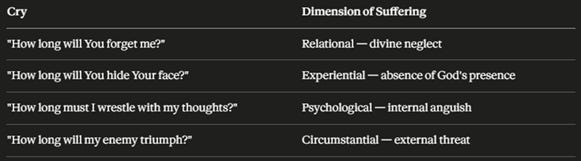
“How Long Will You Forget Me?” — The Relational Wound
The first face of the wound is relational, and what makes it particular is not the pain of absence but the pain of presence without fulfillment. It is the anguish of being in a relationship that is alive and active and real while the promise made within that relationship remains unanswered. If you have never felt it you may think it is a minor form of suffering. If you have felt it you know it is one of the most disorienting kinds of pain a human soul can carry, because it never lets you conclude cleanly either that the relationship is broken or that the promise still stands. It is loneliness inside a marriage, where the other person is there and the covenant is intact and the silence between you has stretched long enough to feel like a verdict on something you cannot name.
Abraham lived this wound for a quarter of a century, and the actual arc is a sustained portrait of what happens to a person who receives a personal word from God and then waits, and watches the circumstances argue against the word in every direction, and slowly, against his own theology, begins to help the promise along in ways that produce consequences he cannot undo. The story is not primarily about Abraham’s failure. It is about the shape of God’s faithfulness continuing to protect a promise the recipient cannot feel Him keeping.
Abraham was seventy-five when the call came, and the language of it was intimate before it was covenantal. God did not send a messenger or appear in a vision to be interpreted by professionals. He came directly, by name, and told Abraham to leave his country and his people and his father’s household and follow Him to a land He would show him, and in the same breath God laid out a cascade of promises that any reasonable ancient man would have counted as more than a lifetime could contain. A great nation. A blessing. A great name. Descendants that would outnumber counting. Every family on the earth blessed through him. This was a word addressed to one man in one moment with his name on it, and the word was so personal and so specific that everything Abraham did next was measured against it.
The very first thing that happened after he obeyed was a famine so severe that it drove him out of the land God had promised and down into Egypt, where fear got the better of him and he told Sarah to say she was his sister because he assumed the Egyptians would kill him for her sake. Pharaoh took her into his palace. And what happened next demonstrates how God works during the wait. “The Lord inflicted serious diseases on Pharaoh and his household because of Sarai, Abram’s wife,” Genesis 12:17 says, and Pharaoh, having no idea why his house was collapsing, discovered the deception and sent Sarah back with a rebuke. God protected the promise Abraham had compromised, and He did it without telling Abraham He was doing it, and the pattern of that quiet unseen faithfulness would repeat itself again and again across the twenty-five years to come.
The years passed. Abraham built altars and moved his flocks and watched Sarah not conceive, and finally, Abraham said out loud what he had been carrying underneath the silence. “Sovereign Lord, what can you give me since I remain childless and the one who will inherit my estate is Eliezer of Damascus? You have given me no children; so a servant in my household will be my heir.” That is the voice of a man doing the math on his own life, watching the timeline collapse, resigning himself to a workaround because the direct fulfillment of the promise has become mathematically impossible in his imagination. God’s answer was to take him outside and show him the night sky. “Look up at the heavens and count the stars, if indeed you can count them. So shall your offspring be. This man will not be your heir, but a son who is your own flesh and blood will be your heir.” Abraham believed the Lord, and Genesis says it was credited to him as righteousness. Then Abraham, still holding the ache of the visible impossibility, asked the question every waiting person eventually asks. “Sovereign Lord, how can I know that I will gain possession of it?”
And what God did in response to that question is remarkable. He asked Abraham to bring a heifer, a goat, a ram, a dove, and a pigeon, and to cut the larger animals in half and lay the pieces in two rows facing each other. Abraham, who lived inside the covenant culture of the ancient Near East, would have known immediately what was being staged. This was a covenant ratification ceremony, and the ritual required both parties to walk between the divided animals and invoke destruction upon themselves if they broke the terms of the agreement. The message was blood-serious: may what has happened to these animals happen to me if I fail to keep my word. Abraham prepared the pieces and waited for God to walk with him between them. But that is not what happened. A deep sleep fell on Abraham as the sun was setting, and while he was asleep “a smoking firepot with a blazing torch appeared and passed between the pieces.” God walked both sides. He absorbed both obligations. He signed the covenant unilaterally while Abraham slept through the ratification, and the meaning of the ritual, is that the promise did not rest on Abraham’s faithfulness at any point in the twenty-five years that followed. It rested on the faithfulness of the God who walked the ceremony alone. If the covenant ever broke, the destruction fell on Him. Not on Abraham. Not on Sarah. Not on Isaac when he finally came. The wait was long, but it was underwritten from the beginning by a God who had taken the full weight of the covenant onto Himself while His partner slept.
Even so, more years passed, and Sarah did what most of us do at a certain point in the wait. She started trying to force the promise to arrive on her own initiative and stopped looking to God’s timing. “Now Sarai, Abram’s wife, had borne him no children. But she had an Egyptian slave named Hagar; so she said to Abram, ‘The Lord has kept me from having children. Go, sleep with my slave; perhaps I can build a family through her.’” Her preface reads on the surface like resignation to God’s sovereignty, because the statement that the Lord has kept her from bearing children is correct about the sovereign one who opens and closes the womb. What makes the moment devastating is that her theology was intact and her interpretation of it was still distorted. She took the accurate premise that God had kept her from conceiving and drew from it the conclusion that the promise now needed her help to be fulfilled through another woman’s body. She never stopped believing in the God who spoke to Abraham. She stopped believing that His method for keeping the promise was still viable, and the difference between those two things is where most of us live during the long wait.
This is the most dangerous movement the relational wound produces, and it does not look like unbelief and it does not feel like rebellion. It looks like maturity dressed up as pragmatic problem-solving. It feels like the responsible thing to do given what God has apparently failed to do. We do not stop trusting the promise. We stop trusting the how and the when and the from whom, and we keep the shape of the promise in our hands while quietly abandoning the way God said He would fulfill it. Ishmael was born when Abraham was eighty-six, and Ishmael lived in that household for fourteen years before Isaac arrived, which means the consequence of one decade of relational wound produced fourteen years of collateral damage and many more after that. Abraham and Sarah did not stop believing in God across those fourteen years. They stopped waiting for Him, which is a different thing entirely.
And through all of it, the pattern of God protecting what fear had compromised continued to run underneath their awareness. In Genesis 20, when Abraham was ninety-nine, he did the same thing again in a different location, telling King Abimelech of Gerar that Sarah was his sister. Abimelech took her, and God appeared to Abimelech in a dream. “You are as good as dead because of the woman you have taken; she is a married woman.” Abimelech returned her with the same kind of rebuke Pharaoh had delivered a lifetime earlier. Twice Abraham compromised the vessel of the promise out of fear. Twice God rescued it. Twice Abraham did not know what had been done on his behalf until he was told after the fact by the foreign king he had lied to.
Genesis 17 marks the moment God gave the promise a specific name. Abraham was ninety-nine and Sarah was eighty-nine, and the announcement should have arrived as vindication after decades of waiting, but the announcement arrived through God’s own gentle irony. He told Abraham that the son would be called Isaac, and Isaac in Hebrew means he laughs. Abraham fell facedown and laughed when he heard it, and the child would carry the name of that laughter permanently, so that every time anyone spoke Isaac’s name across the following centuries they would be reminded of the season of impossibility that had produced him. When three visitors came to Mamre in Genesis 18 and one of them told Abraham that within a year Sarah would have the promised son, Sarah was listening from the tent and laughed to herself, “After I am worn out and my lord is old, will I now have this pleasure?” And God turned to Abraham and asked why Sarah had laughed, and then He asked the question that hovers over every doubt any of us have ever cast at the promises He has spoken to us privately. “Is anything too hard for the Lord?” Sarah, from inside the tent, lied and said she had not laughed. God said simply, “Yes, you did laugh,” and He did not rebuke her, and He did not withdraw the promise, and He named the laughter honestly and let the promise stand.
One year later, “the Lord was gracious to Sarah as he had said, and the Lord did for Sarah what he had promised. Sarah became pregnant and bore a son to Abraham in his old age, at the very time God had promised him.” At the very time God had promised. Not early and not late but exactly at the moment He had said. The whole story reorganizes itself around that sentence, because it tells us that the wait was not evidence of God’s inattention but the timing He had chosen, and the silence was not absence but the specific texture of the timing being kept, and the invisible protection of the vessel through Egypt and Gerar was not accidental but the sovereign, hidden, continuous work of a God who had signed the covenant alone while His partner slept through the ratification and had never stopped honoring the terms He had taken upon Himself.
There is a season some of us are living from inside this exact wound that caused Abraham and Sarah to blunder. God spoke to you, personally, specifically, with a word that had your name in it, and the years since have been long enough that you have started to do the math Sarah did, not by concluding that the promise was false but by concluding that it must now need your help. The Sunday attendance has continued. The prayer has continued. The relationship has never ended. But the specific thing He said has not arrived, and somewhere in the interior you have started building what looks like Hagar, though it may not look like that on the surface. It may look like a relationship God did not sanction that carries just enough of the shape of the promise to feel like wisdom. It may look like a career move He did not authorize that produces the appearance of the outcome without the substance of the fulfillment. It may look like a shortcut that lets you tell yourself you are still trusting God while quietly relieving Him of the burden of doing what He said. You are in relational exhaustion, and the Hagar you are building is not the promise. It is evidence that you stopped waiting for the Promise-Keeper’s way of keeping it.
God walked through those pieces alone. He was the only one whose faithfulness the covenant ever required. He has protected what your fear nearly gave away, more than once, without telling you He did it. He named the child after your doubt so the testimony would be complete, and He has not stopped working for you.
We pray:
Lord,
Teach us how to wait without reaching for what You have not given.
You know the places where Your silence has begun to feel like absence, where the delay has stretched long enough that we have started doing the math without You. You know where we have called fear wisdom, where we have dressed impatience in the language of responsibility, and where we have tried to build a version of the promise that does not require us to trust Your timing.
Forgive us for the Hagars we have created in our hearts. Forgive us for the shortcuts we have entertained, the compromises we have justified, and the places where we have tried to protect ourselves from the pain of waiting by taking into our own hands what You never asked us to carry.
But thank You, Lord, that Your faithfulness has been deeper than our fear. Thank You for protecting what we nearly gave away. Thank You for working while we were unaware, for guarding the promise when our hands were unsteady, and for remaining true even when our waiting became wounded.
Help us trust not only what You said, but how You choose to fulfill it. Help us believe that Your delay is not neglect, Your silence is not abandonment, and Your timing is not cruelty. Keep us from manufacturing Ishmael because we have grown tired of waiting for Isaac.
Let our souls learn to say with David, even before the answer comes, “We trust in Your unfailing love.” Let our hearts rejoice in Your salvation before our circumstances change. And when the promise finally arrives, let the testimony be honest enough to include our fear, our laughter, our weakness, and Your mercy over it all.
You are the God who keeps covenant while Your people sleep. You are the God who remembers what we fear You have forgotten. You are the God who fulfills what only You can fulfill.
So we wait again.
Not because waiting is easy, but because You are faithful.
Amen.